
Park a car in Kapolei for even a few months and you’ll understand why paint protection isn’t optional here — it’s survival gear. Between the relentless UV index, salty coastal air, tropical downpours, and afternoons spent in beach parking lots, Hawaii’s climate is one of the toughest environments in the country for automotive paint. Owners who move here from the mainland are often surprised at how quickly a factory finish can start to look tired — a black truck that would hold its gloss for years in a milder climate can show chalky patches on the hood within a single Oahu summer. If you’re weighing ceramic coating vs wax, you’re really asking a bigger question: how do I keep my car looking new while living somewhere that seems determined to fade, dull, and oxidize it?
This guide breaks down exactly how traditional wax and ceramic coating perform against Kapolei conditions, what each option actually costs over time, and which one makes sense for your daily driver, truck, SUV, Tesla, or weekend sports car. We’ll walk through how each product works at a chemical level, compare them side-by-side across the factors that actually matter for Hawaii ownership, and look at a real one-year case study showing what happens to two similar vehicles parked in the same environment. By the end, you should have a clear, practical answer — not just a marketing pitch — for which option fits your vehicle, your budget, and how long you plan to keep it looking sharp.
Why Paint Protection Matters in Kapolei
Oahu’s leeward side, including Kapolei, Ewa Beach, and Waipahu, sees some of the highest UV exposure in the Hawaiian Islands. Unlike a mainland car that might spend winter months shielded from the sun, vehicles here face intense UV nearly every day of the year, with little seasonal relief. Add in coastal humidity, salt air drifting in from the shoreline, tree sap, bird droppings, and road grime from daily commutes, and your clear coat is under constant, compounding assault rather than the occasional exposure most paint protection products were originally designed around.
This is what separates Kapolei ownership from garage-kept cars in cooler, drier climates: the damage isn’t a single event, it’s cumulative. Every week without adequate protection adds a little more UV breakdown, a little more salt residue, a little more etching from acidic rain. Here’s what that environment does to unprotected paint over time:
- UV rays break down the resins in clear coat, causing fading and chalky oxidation — especially visible on black and dark-colored vehicles.
- Salt air accelerates corrosion and clouds paint clarity.
- Tropical rain carries acidic contaminants that etch into unprotected clear coat.
- Frequent washing, which Hawaii vehicles need more than most, gradually strips wax protection.
- Beach parking exposes paint to sand, salt spray, and prolonged sun with little shade.
Without a protective layer, oxidation and fading aren’t a matter of if — they’re a matter of when. Most owners notice it first on horizontal surfaces like the hood, roof, and trunk lid, where sun exposure is most direct, before it spreads to vertical panels. That’s why the ceramic coating vs traditional wax decision matters so much for anyone serious about long-lasting paint protection in Hawaii — the right choice can be the difference between a car that still turns heads at year five and one that already looks tired by year two.
What is Traditional Car Wax?
Car wax is a surface-level protective layer, typically made from carnauba wax, synthetic polymers, or a blend of both. It sits on top of the clear coat and creates a temporary barrier against UV rays, water, and light contamination — think of it less as armor and more as a sacrificial coat that absorbs environmental damage so the paint underneath doesn’t have to.
Key characteristics of wax:
- Carnauba wax delivers a warm, deep gloss but breaks down quickly in heat and UV exposure.
- Synthetic wax (paint sealant) lasts slightly longer and offers more consistent protection.
- Protection level is modest — wax repels light water and dust but offers little defense against chemical etching or prolonged UV.
- Lifespan typically runs 4-8 weeks in Hawaii’s climate before it begins breaking down.
- Maintenance requires reapplication every 1-2 months to maintain any meaningful protection.
Wax has been the default paint protection product for decades because it’s affordable, easy to apply, and gives an instant visual improvement — even a quick coat can make tired paint look refreshed for a weekend. But in a climate as demanding as Kapolei’s, that short lifespan becomes a real liability. By the time most owners get around to their next reapplication, the previous layer has often already broken down weeks earlier, leaving the paint effectively unprotected during the gap.
What is Ceramic Coating?
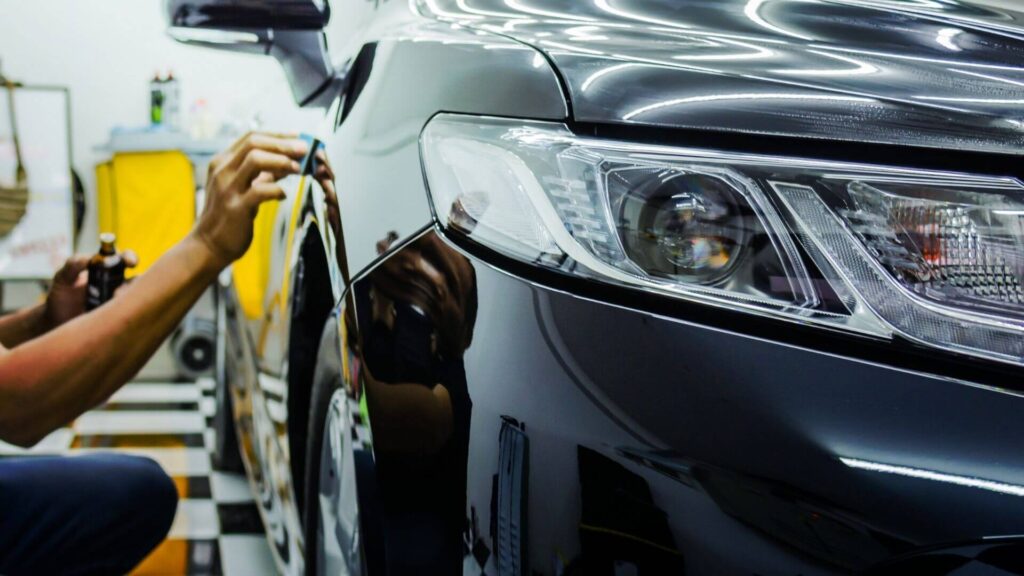
Ceramic coating is a liquid polymer built around silicon dioxide (SiO2) that chemically bonds to your vehicle’s clear coat rather than simply sitting on top of it. Once cured, it forms a semi-permanent, glass-like layer that fundamentally changes how paint interacts with its environment. Where wax behaves like a topcoat that eventually wears away, ceramic coating becomes part of the surface itself — which is the core reason it holds up so much longer against Hawaii’s UV and salt exposure.
How ceramic coating works:
- SiO2 technology fills in microscopic pores in the clear coat, creating a smooth, dense molecular barrier.
- Bonding to clear coat means the coating becomes part of the paint’s surface chemistry, not just a topical layer.
- Hydrophobic effect causes water to bead and roll off instantly, taking dirt, salt residue, and grime with it.
- UV resistance is dramatically higher than wax, slowing oxidation and color fading even under Hawaii’s intense sun.
- Chemical resistance protects against bird droppings, tree sap, and acidic contaminants that would otherwise etch into unprotected paint.
This is why Ceramic Coating Kapolei services have become the go-to solution for vehicle owners who want protection that actually keeps pace with the local climate instead of wearing off within weeks.
Ceramic Coating vs Wax Comparison
| Factor | Traditional Wax | Ceramic Coating |
|---|---|---|
| Durability | 4-8 weeks | 2-5+ years (professional grade) |
| Gloss | Warm, deep shine | High-gloss, glass-like finish |
| Maintenance | Reapply monthly | Occasional maintenance wash |
| UV Protection | Minimal, short-lived | Strong, long-term resistance |
| Chemical Resistance | Low | High |
| Water Beading | Moderate, fades quickly | Strong, consistent beading |
| Scratch Resistance | Very low | Improved surface hardness, not scratch-proof |
| Longevity | Short-term | Long-term investment |
| Cost | Low upfront, recurring | Higher upfront, lower over time |
| Maintenance Frequency | High | Low |
| Appearance | Good, temporary | Excellent, sustained |
| Environmental Resistance | Weak against salt/UV | Strong against salt, UV, humidity |
Real Hawaii Example: A One-Year Case Study
To make this comparison practical, consider two similar Kapolei vehicles over a 12-month period:
Vehicle A — a dark gray SUV, waxed every two months by its owner, parked outdoors near Ewa Beach.
Vehicle B — an identical model, professionally ceramic coated at the start of the year and parked in the same conditions.
After one year:
- Vehicle A shows visible oxidation on the hood and roof, a duller finish, and water spots that no longer bead off during rain. The owner has applied wax six times and still sees fading beginning on high-UV panels.
- Vehicle B still exhibits strong hydrophobic water beading, a noticeably deeper gloss, and no visible oxidation. Washing takes less time because dirt and salt residue don’t cling to the surface the way they do on Vehicle A.
This is a realistic outcome, not an exaggeration — it’s the direct result of how differently these two products interact with sun, salt, and rain over time. The gap doesn’t appear overnight; it builds gradually, week by week, as one surface keeps shedding contamination and resisting UV breakdown while the other slowly loses the battle between reapplications. Owners who compare their car to a neighbor’s ceramic coated vehicle after a year are often surprised by how much of a visible difference a single protective decision can make.
Cost Comparison: What You’re Really Paying For
Wax feels cheaper upfront, but the math changes once you factor in Hawaii’s climate demands:
- Wax owner: Roughly 6-8 applications per year, whether DIY (time + product cost) or professional application, adds up over several years to a similar or higher total cost than a single ceramic coating — with far less protection to show for it.
- Ceramic coating owner: One professional installation covers 2-5+ years, with minimal maintenance beyond regular washing.
When you account for the labor, product costs, and the compounding paint damage a wax-only approach allows, ceramic coating is often the better long-term investment — not just for appearance, but for long-term cost savings and preserved vehicle value at resale. A car that arrives at a dealership or private sale with a deep, unblemished finish typically commands a stronger offer than one showing years of sun fading and swirl marks, which means the upfront cost of a professional coating can partially pay for itself down the road.
Who Should Choose Wax?
Wax still has a place for some owners:
- Those planning to sell or trade in a vehicle very soon
- Owners who enjoy the hands-on detailing process as a hobby
- Vehicles needing a quick, temporary gloss boost before an event
- Budget-conscious owners not ready for a larger upfront investment
Who Should Choose Ceramic Coating?
Ceramic coating makes the most sense for:
- Daily drivers exposed to Hawaii’s sun and salt air year-round
- Luxury vehicles and Teslas where paint value and appearance matter
- Trucks and SUVs frequently parked near the beach
- Sports cars owners want to keep showroom-glossy
- Anyone tired of reapplying wax every few weeks
- Owners focused on long-term vehicle value and resale condition
If you’re unsure which category you fall into, choosing a ceramic coating installer with real experience can help you evaluate your vehicle’s specific needs.
Why Professional Installation Matters
Ceramic coating performance depends heavily on how it’s applied. A rushed or DIY application can trap contaminants beneath the coating or cure unevenly, undermining the very protection you’re paying for. Professional installation typically includes:
- Preparation — a full wash and inspection to assess paint condition.
- Paint correction — removing swirl marks, light scratches, and oxidation before coating.
- Surface decontamination — clay bar treatment and chemical decontamination to strip embedded grime and residue.
- Application — precise, panel-by-panel application under controlled conditions.
- Curing — proper cure time, often with heat assistance, to ensure the coating fully bonds.
Skipping any of these steps shortens the coating’s lifespan and can trap imperfections under a glossy — but flawed — surface. This is the biggest reason DIY ceramic coating kits often underperform their professional-grade counterparts: without proper paint correction and decontamination beforehand, even a good product is bonding to a surface that’s already compromised.
Why Love’s Auto Detail is Trusted in Kapolei
Love’s Auto Detail has built its reputation on understanding exactly how Hawaii’s climate affects vehicle paint — because it’s the environment the team works in every day. That local experience shapes every step of the process, from paint correction to final cure.
What sets the team apart:
- Local experience with Oahu’s UV exposure, salt air, and coastal conditions
- Professional-grade products built for long-term chemical and UV resistance
- Paint correction expertise that ensures coatings go on a properly prepped surface
- Attention to detail across every panel, not just the visible ones
- Customer service that walks owners through which protection level fits their vehicle and budget
Whether you’re in Kapolei, Waipahu, or Ewa Beach, the team offers dedicated resources for each community: see the ceramic coating experts serving Kapolei, the professional ceramic coating options available in Waipahu, and the ceramic coating installation services offered in Ewa Beach.
For a deeper look at how to evaluate installers before booking, read the Expert Guide to Finding the Best Ceramic Coating Service in Kapolei or explore finding the best ceramic coating in nearby Waipahu.
Conclusion
Wax has a place — it’s affordable, easy to apply, and gives a quick gloss boost. But in Kapolei’s climate, its short lifespan means constant reapplication just to keep pace with UV exposure, salt air, and tropical rain. Ceramic coating, by contrast, chemically bonds to your clear coat and delivers years of hydrophobic, UV-resistant, chemical-resistant protection with far less upkeep.
If you’re comparing ceramic coating vs wax for a vehicle you plan to keep looking sharp for years — not just weeks — ceramic coating is the clear long-term winner for Hawaii ownership.
Ready to protect your paint the right way? Book a professional ceramic coating consultation with Love’s Auto Detail today. Serving Kapolei, Waipahu, Ewa Beach, and all of Oahu, our team will inspect your vehicle, walk you through the right protection level, and help you avoid the fading, oxidation, and constant maintenance that come with wax alone.
Frequently Asked Questions
What lasts longer, wax or ceramic coating?
Ceramic coating lasts significantly longer than wax. Professional-grade ceramic coatings last 2-5+ years, while wax typically breaks down within 4-8 weeks, especially in Hawaii’s UV-heavy climate.
Can ceramic coating replace wax?
Yes. Ceramic coating provides stronger, longer-lasting protection than wax and eliminates the need for frequent wax reapplication. Some owners add a spray wax on top for extra gloss, but it’s optional, not necessary.
Is ceramic coating worth it?
For most Kapolei vehicle owners, yes. While the upfront cost is higher than wax, the multi-year protection, reduced maintenance, and preserved paint condition often make it the more cost-effective choice over time.
Will ceramic coating stop scratches?
Ceramic coating adds surface hardness and some resistance to light swirl marks, but it is not scratch-proof. It won’t prevent deep scratches from keys, rocks, or careless contact.
How often should I wax my vehicle?
In Hawaii’s climate, wax typically needs reapplication every 4-8 weeks to maintain meaningful protection against UV and moisture.
How long does ceramic coating last?
Professionally applied ceramic coatings typically last between 2 and 5 years, depending on the product used, vehicle care, and exposure conditions.
Can ceramic coating be applied to older paint?
Yes, but older or oxidized paint usually needs paint correction first. This removes existing oxidation and imperfections so the coating bonds properly to a clean, restored surface.
Does ceramic coating make washing easier?
Yes. The hydrophobic surface causes dirt, salt residue, and water to slide off more easily, reducing the time and effort needed for regular washing.
Is ceramic coating good for Hawaii weather?
Very much so. Its strong UV resistance and chemical resistance are particularly effective against Hawaii’s intense sun, salt air, and tropical rain — conditions that break down wax quickly.
How much maintenance does ceramic coating require?
Minimal. Regular washing with pH-neutral soap is typically all that’s needed, compared to the monthly reapplication wax requires.
Does Hawaii weather affect paint?
Yes. UV exposure, salt air, humidity, and tropical rain all accelerate oxidation and fading, especially without a protective coating or regular waxing.
Why does wax wear off?
Wax sits on top of the clear coat rather than bonding to it. UV heat, washing, and rain gradually break down and remove this surface layer, which is why it needs frequent reapplication.